+1 (214) 872 7517
  +1 (647) 361 7894
  +91 956 604 8693
 Workday HCM Course | Workday Online Training & Certification
Table of Contents
Table of Contents
- What is a Workday HCM Course?
- Why Take a Workday HCM Course?
- Key Learning Objectives of a Workday HCM Course
- Workday HCM Course Curriculum
- Different Types of Workday HCM Courses
- Duration & Format of Workday HCM Courses
- Workday HCM Course Fees & Cost Factors
- Workday HCM Course with Certification
- Career Opportunities After Workday HCM Course
- Choosing the Best Workday HCM Course Provider
- How ERP Cloud Training Helps You Succeed?
- Conclusion
Business organizations from all across the globe are adopting cloud Human Capital Management solutions at a very rapid pace. Among them, Workday HCM continues to stand out as the most efficient, innovative, & future-ready HR platform. No matter if it is a multinational enterprise or a fast-growing mid-size firm, HR leaders are increasingly turning to Workday to transform their hiring, payroll, workforce planning, learning processes, & performance.
A Workday HCM Course helps professionals master these skills. It teaches how to configure, implement, and manage Workday HCM to support real-world HR and business processes. Because Workday is widely used in the United States, Asia-Pacific, Europe, & the Middle East, the demand for trained professionals has never been higher.
Here we have covered everything you need to know about Workday HCM Online Course, which includes the formats of training, learning outcomes, careers, salaries, certification, & how to choose the best program.
What is a Workday HCM Course?
A Workday HCM Course is a well-structured training program and Workday HCM Tutorial that efficiently teaches learners how to use Workday Human Capital Management. The goal of this training program is to build those skills that improve HR operations, analytics, reporting, & decision-making.
A typical Workday HCM course is strategically designed to offer end-to-end exposure to the platform. The major learning components include the following:
■ Core HR Concepts
• Covers organizational structure, staffing models, positions, jobs, & data of employees.
• Help learners to thoroughly understand how transactions & records flow through Workday.
• Builds the desired level of confidence in navigating screens, menus, & all Workday functions.
■ Business Process Configuration
• Teaches how to create & modify hiring, termination, promotion, & approval workflows.
• Focuses on routing, notifications, & automation to match the rules of real business.
• Enables students to customize processes for various departments.
■ Payroll & Compensation
• Training on earnings, deductions, pay grades, tax calculations, & merit cycles.
• Key for payroll analysts, HR teams, & compensation specialists.
• Ensures the right level of accuracy in salary, bonuses, & workforce cost planning.
■ Recruitment Drive & Onboarding
• Learners practice job requisitions, offers, candidate pipelines, & onboarding tasks.
• Ensures smooth transition from hiring to creation of employee records.
■ Security & Compliance
• Covers user roles, data privacy, access controls, & governance policies.
• Helps to maintain confidentiality & meet all regulatory standards.
■ Reporting, Dashboards, & Analytics
• Students build custom reports, scorecards, & visual dashboards.
• Learn how to support decision-making with the help of the available insights.
■ Integrations & Real-Time Scenarios
• Practical exposure to connecting Workday with various external systems.
• Hands-on exercise sessions that simulate the real workplace challenges & solutions.
Which Individuals Should Opt for the Workday HCM Course?
Anybody who is interested to learn Workday HCM can opt for this course. However, the course is apt for the following professionals:
• HR professionals
• Finance & payroll specialists
• System analysts & IT consultants
• Students & job seekers
• Functional analysts
• Project managers
• Business leaders who are looking forward to switching careers
No programming background is necessarily required for most Workday HCM Training Courses, though familiarity with the various mainstream HR processes helps a lot for the trainees of this program.
Why Take a Workday HCM Course?
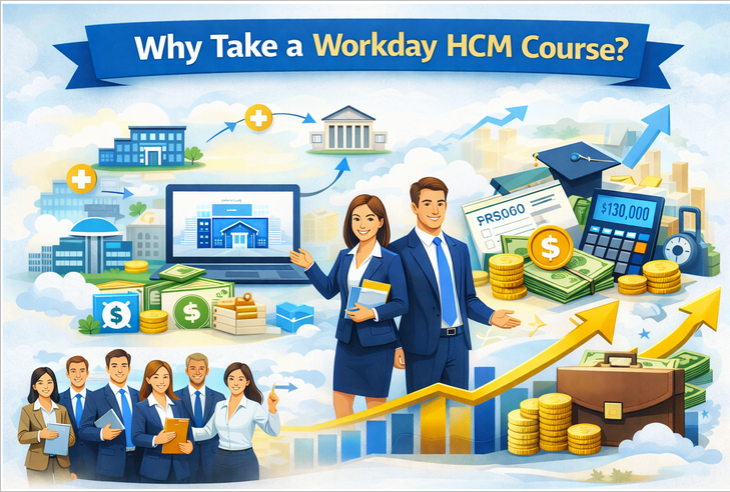
Career Demand & Salary Potential
The adoption of Workday is growing rapidly. Thousands of forward-looking business organizations that believe in modern & efficient business practices use Workday HCM, including:
• Healthcare systems
• Fortune 500 corporate companies
• Universities
• Financial services organizations
• Retail & manufacturing companies
• Government entities
As a result, the salaries in the Workday roles are highly lucrative.
The typical salary ranges in the US are depicted below:
| Role | Average Annual Salary (US) |
|---|---|
| Workday HCM Consultant | It ranges between $105,000 to $155,000 |
| Workday Payroll Analyst | It ranges between $95,000 to $135,000 |
| Workday HRIS Analyst | It ranges between $90,000 to $145,000 |
| Workday Functional Consultant | It ranges between $120,000 to $170,000 |
Experienced consultants often earn even more than the quoted figures in the above table.
Adoption of Workday HCM Across Industries
IDC, Forrester, & Gartner have been considering Workday as an industry leader. Business enterprises usually adopt Workday for the following purposes:
• Unified HR & Finance platform
• Global compliance
• All analytics are in real time
• Cloud security & reliability
• Scalable architecture
Skills in the field of Workday HCM are completely transferable across various industries.
Hands-On Skills that Matter More Than Only Theory
Recruiters of today’s time look for real-time experience with:
• Tenant access
• Business process setup
• Configurations
• Integrations
• Reports & dashboards
A good Workday HCM Course includes practical labs, & not just theory.
Placement & Career Growth Benefits
Training providers now include:
• Resume building
• Placement assistance
• Project assignments
• Mock interviews
• Certification preparation
Several learners secure a job or promotion within a matter of months after training.
Key Learning Objectives of a Workday HCM Course
Understanding Workday HCM Fundamentals
Learners gain a robust foundation in:
• Jobs, positions, organization
• Workforce structures
• Supervisory hierarchy
Navigating the Workday HCM Interface
The training covers the following aspects:
• Navigation basics
• Dashboards & worklets
• Workday search
Managing HR, Payroll & Talent Processes
Participants learn how to manage:
• Hiring
• Onboarding
• Compensation
• Tracking time
• Absence management
Configuring Business Processes
A major feature of Workday is that it consists of a highly customizable business processes. The training necessarily includes:
• Steps
• Conditions
• Notifications
• Approvals
Creating Reports & Dashboards
Reporting is critical. Students learn:
• Custom reports
• Calculated fields
• Advanced reports
• Dashboards
Integrations & Real-Time Scenarios
Courses introduce the following:
• Workday Studio
• Core connectors
• EIB (Enterprise Interface Builder)
Real-time scenarios that help build the desired level of confidence.
Workday HCM Course Curriculum
A complete Workday HCM Full Course is strategically designed to provide learners with the most important practical knowledge of every core area within the system. The curriculum of this course typically includes the following structured modules:
Core HR Module Training
This particular section forms the robust foundation of the program. Students learn how Workday represents progressive business organizations & people.
• Supervisory organizations – This teaches building organizational hierarchy, department mapping, & leadership flow.
• Positions & Jobs – It helps you to know about creating roles, assigning job profiles, managing vacancies, & job classifications.
• Staffing – This chapter teaches about hiring, transfers, promotions, terminations, & other workforce lifecycle activities.
These concepts are very crucial for anyone who will manage employee records or configure HR operations.
Talent Management & Performance
This particular module focuses largely on developing & retaining employees.
• Goals – The major goals here are to set up & track performance targets.
• Feedback – The receiving of continuous input and review from the managers & peers.
• Planning of succession – Identifying all the future leaders, critical roles, also the various development pipelines.
Participants learn to drive engagement & performance by using the Workday tools.
Payroll & Compensation
This component largely teaches how salaries & payments are being calculated & managed.
• Pay groups – Grouping employees by payroll cycles.
• Earnings and deductions – Salary, insurance, allowances, taxes, & other adjustments.
• Compensation bands – Pay ranges, grades, & merit policies.
Learners understand how compensation flows into payroll & reporting.
Time Tracking & Absence
Managing time is highly essential in most organizations.
• Leave plans – Vacation, holidays, sick leave, & custom plans.
• Work schedules – Weekly hours, shifts, & calendars.
• Timesheets – Employee approvals, time entry, & validations.
This module deals with teaching productivity, compliance, and payroll accuracy.
Recruitment & Onboarding
Students usually come across various lucrative opportunities to understand how to effectively manage the process of hiring end-to-end.
• Job requisitions – The trainees learn how to create and post the vacancies with a proper and elaborate job description, introduction & location of the job.
• Candidate pipelines – Managing all activities, including screening, interview rounds, assessments, & tracking.
• Offer management – Creating offers, approvals, and onboarding tasks.
It prepares learners for HR, recruiting, & hiring roles.
Reporting & Analytics
Workday is very powerful when used for insights & decision-making.
• Workday Report Writer – In this module, it is taught how to build custom reports from live data.
• Dashboards – You learn how to build and manage the dashboards, which include visual KPIs, charts, & scorecards.
• KPIs – You learn to track the KPIs, which include metrics like headcount, turnover, & payroll cost.
Students learn thoroughly how to turn data into the most actionable strategies.
Business Process Configuration
This module thoroughly explains how automation works.
• Approvals – It is highly helpful in managing the multi-level chains of approval.
• Routing – Assigning the designated tasks to the right person at the right time.
• Conditions – The business rules that are based on geography, roles, or departments.
It strongly ensures optimum accuracy & efficiency across the platform.
Security & Compliance
Security is highly essential for protecting all sensitive HR data.
• Domain security – This module teaches how to control access to specific data & objects.
• Role assignments – It is taught how to grant access based on job role, function, or hierarchy.
• Compliance standards – This module explains how to follow regulations, audits, & data protection policies.
Participants learn how to maintain confidentiality & governance.
Integrations & Studio Overview
This particular module covers connectivity with external systems.
• EIB (Enterprise Interface Builder) – It teaches simple imports & exports.
• Core connectors – This module consists of payroll, benefits, and third-party applications.
• Studio basics – It teaches advanced development & complex integrations.
This knowledge is highly useful for technical & IT consultants or integration specialists.
Real-Time Scenarios & Case Studies
Courses conclude with practical experience:
• Hands-on practice – It is one of the most essential parts of the Workday HRM course and involves performing real HR transactions.
• Live projects – The engagement of the trainees in Live Projects exposes them to end-to-end scenarios mirroring workplace challenges.
These particular exercises prepare learners for certification exams along with project roles. These topics prepare learners for Workday HCM Certification Course exams.
Different Types of Workday HCM Courses
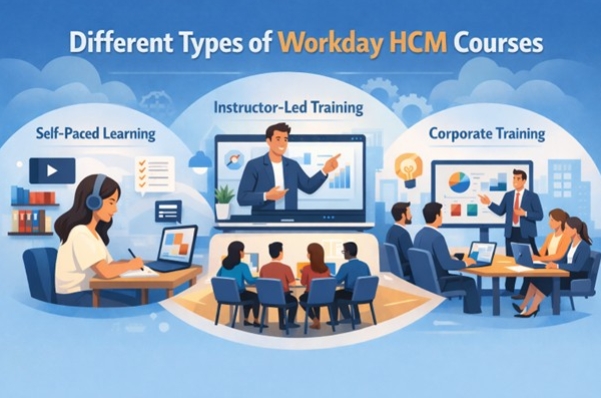
There are three major training formats:
Self-Paced Program & Course Materials
• Recorded videos
• Learn anytime
• Limited interaction
• Affordable
• No fixed class timings or deadlines
Courses led by Instructors
• Live online classes
• Faster learning
• Expert guidance
• Hands-on training session
• Open Q&A with the instructor
• Practical demonstrations in a live tenant
• One-on-one support with the trainer
Corporate Training Programs
• Tailored to company needs
• Enterprise support
• Internal teams are training together
• Team collaboration and knowledge sharing
• Customized learning paths for employees
• Flexible scheduling to fit business operations
| Feature | Self-Paced | Instructor-Led | Corporate |
|---|---|---|---|
| Schedule | Flexible | Fixed | Custom |
| Interaction | Low | High | Very High |
| Live Projects | Optional | Included | Included |
| Cost | Low | Medium | High |
| Best For | Individuals | Job seekers | Enterprise teams |
Duration & Format of Workday HCM Courses
The typical duration of Workday HCM Courses varies:
• Short-Term Boot camps: They range from four to six weeks
• Full Courses: The program is generally two to four months
• Corporate programs: The duration of Corporate programs is customizable.
The formats include the following:
• Online live sessions
• Virtual labs
• Recorded video modules
• 24/7 tenant access
Learners often work on Workday Live Projects, which simulate the real-life implementation tasks.
Workday HCM Course Fees & Cost Factors
Average Fee Range
Course fees depend on provider & features:
• $600 – $2500 per person for standard courses
• $2,500+ for corporate training
What Influences Cost?
• The experience of the instructor
• Duration of the course
• Access to a live tenant
• Projects included
• Certification preparation
• Career guidance & Mentorship
ROI: Why It’s Worth It
With salaries ranging from $95k – $170k, premium training pays off very quickly.
Workday HCM Course with Certification
Training & certification are different. Course Completion vs. Official Certification
| Course | Certification |
|---|---|
| Provided by the training institutes | Provided by Workday |
| Teaches Workday HCM skills | Validates Workday HCM skills |
| Includes projects | Requires exam |
How Training Helps You Pass
Learners gain:
• Thorough domain knowledge
• Labs & exercises
• Study materials
• Mock tests
Steps to Achieve Workday HCM Certification
1. Receive access through the employer or partner.
2. Prepare using mock exams.
3. Complete training.
4. Take the certification test.
Career Opportunities After Workday HCM Course
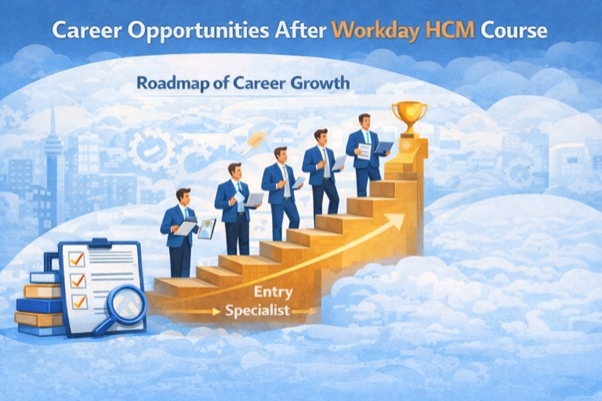
Job Roles
• Workday HCM Consultant
• Workday Payroll Analyst
• HRIS Specialist
• Workday Integration Analyst
• Talent Management Consultant
Expectations of Salary by Region
| Region | Average Salary |
|---|---|
| US | $105k – $160k |
| Canada | CAD $90k – $140k |
| UK | £55k – £90k |
| UAE | AED 240k – AED 360k |
Companies Hiring Workday Professionals
Workday is being widely used by:
• Amazon
• Walmart
• Deloitte
• Netflix
• PwC
• Accenture
• Bank of America
• Google
• Ford
• Salesforce
Roadmap of Career Growth
Entry roles → Specialist → Senior Analyst → Lead Consultant → Architect
Choosing the Best Workday HCM Course Provider
What to Look For
• Certified & experienced instructors
• Tenant access
• Real-time projects
• Certification guidance
• Placement support
• Flexible scheduling
Comparison Checklist
| Criteria | Must Have |
|---|---|
| Real-time tenant | Yes |
| Projects | Yes |
| Placement assistance | Yes |
| Certification prep | Yes |
| Instructor experience | 10+ years preferred |
Why ERP Cloud Training?
• Industry-recognized trainers
• Mock exams
• Hands-on labs
• Resume + interview support
How ERP Cloud Training Helps You Succeed?
A good training provider should necessarily offer more than just videos. ERP Cloud Training delivers the following:
• Personalized learning
• Expert trainer
• Capstone projects
• Real-time tenant access
• One-on-one interaction
• Certification support
• Downloadable documents
• Cheat sheets
• LMS Access
• Placement Assistance
• Career guidance & Mentorship
Students at the end of the course graduate career-ready with the optimum level of confidence.
Conclusion
A Workday HCM Online Course helps in equipping professionals with all the essential skills that are needed to manage payroll, HR, recruiting, & analytics in a modern enterprise environment. The right combination of hands-on training, real-time projects, & certification preparation gives learners a highly competitive edge.
No matter if you are an HR leader, job seeker, or IT consultant, mastering Workday HCM opens doors to high-paying careers across various industries. Demand for certified Workday HCM professionals is strong, their salaries are high, and the opportunities are global.
If you are looking to upgrade your HR or technology career, a Workday HCM Course is surely one of the smartest investments that you can make.
Frequently Asked Questions (FAQ)
1. What is the usual duration of a Workday HCM course?
It usually takes between 6 weeks & 12 weeks, depending on the HCM course’s format.
2. Do I require prior technical or HR experience?
No, it is not mandatory to have prior technical or HR experience. However, it helps if you have prior HR or technical experience. Courses usually start with the fundamentals.
3. Am I supposed to receive a certificate after completing the course?
Yes, you will surely receive a course completion certificate. Official Workday certification requires access through an employer or partner.
4. Can I learn Workday HCM online?
Yes. Most of the programs offered as Workday HCM courses online with live instructors & hands-on labs can be opted for by trainees.
5. What is the difference between the Workday HCM Course & Workday Certification?
• A course teaches skills.
• Whereas a certification is meant to validate skills via an exam from Workday.