What is Workday? A Complete Guide to the Workday System, Modules & Uses
 Mary Kavin
What is Workday? Discover its cloud ERP platform, key modules, benefits, AI capabilities, career opportunities, & how to learn start your Workday care
Table of Contents
- Introduction
- What is Workday?
- Workday at a Glance
- History of Workday
- What Does Workday Do?
- What is Workday Used For?
- How Does Workday Work? (Workday System Architecture)
- The Workday Platform & Core Solutions
- Key Workday Modules & Solutions Explained
- What is Workday Extend?
- Key Workday Terms You Should Know (Glossary)
- Top Benefits of Workday
- Limitations & Challenges of Workday
- Workday vs. SAP vs. Oracle & Other Alternatives
- Who Uses Workday? (Companies & Industries)
- The Future of Workday (AI & 2026 Updates)
- Why Learn Workday? Career Scope, Roles & Salary
- How to Learn Workday (Getting Started Path)?
- Conclusion
- FAQ
Introduction
Enterprise software has notably evolved over the past decade, and cloud-native platforms have become the preferred choice for several progressive organizations of different sizes seeking the right level of agility, scalability, and continuous innovation.
Among all of these platforms, Workday has notably emerged as one of the most trusted enterprise cloud solutions for managing Financial Management, Human Capital Management (HCM), Payroll, Planning, and Analytics.
If you are one of the millions out there wondering what is Workday, how it effectively works, what businesses use this platform for, and why it has specifically become one of the fastest-growing enterprise applications across the globe, this particular guide elaborately covers everything that you need to know.
What is Workday?
Workday is a globally popular cloud-based enterprise software platform that effectively helps business organizations from various sectors in managing their workforce, talent, finances, payroll, planning, and business operations through a user-friendly unified system.
Founded way back in the year 2005 by Dave Duffield and Aneel Bhusri, Workday was very strategically built as a modern alternative to the previously prevalent on-site ERP systems. Unlike the various legacy enterprise applications that require highly expensive hardware and also frequent manual upgrades, Workday operates entirely in the cloud, allowing more and more business organizations to access real-time business information from anywhere.
Today, Workday is successfully serving thousands of modern and progressive business organizations and institutions from all across the globe, ranging from fast-growing businesses to the most prominent Fortune 500 enterprises, universities, government institutions, and also leading healthcare organizations.
One of the most obvious and biggest strengths of the Workday system is that it very competently combines finance, HR, payroll, analytics, planning, and reporting into a single platform. This specifically eliminates the potential data silos, considerably improves the overall operational efficiency, and also enables leaders to make faster, data-driven decisions.
Because of its intuitive interface, initiative of continuous innovation, and AI-powered capabilities, Workday has indeed become one of the most widely adopted enterprise cloud platforms that is being used presently across industries.
Workday at a Glance
| Feature | Details |
|---|---|
| Founded | 2005 |
| Headquarters | Pleasanton, California, USA |
| Founders | Dave Duffield & Aneel Bhusri |
| Type of Software | Cloud-based ERP Platform |
| Deployment | SaaS (Software as a Service) |
| Primary Solutions | Finance, HCM, Payroll, Planning, Analytics |
| Industries Served | Healthcare, Education, BFSI, Manufacturing, Government, Retail, Technology, and more |
| Global Customers | Thousands of organizations across more than 175 countries |
History of Workday
Workday was founded in the year 2005 after PeopleSoft founder Dave Duffield partnered with Aneel Bhusri to work together in one direction to create a next-generation enterprise cloud platform.
Their vision was absolutely simple: to build enterprise software that progressive businesses from across industries actually enjoy using and solve their real-life business problems.
Traditional ERP systems at that time, back in 2005, were highly complex, very expensive to maintain, and also required major upgrades every few years. Workday was launched at that time to challenge this model by introducing a cloud-native architecture that delivered automatic updates, modern user experiences, and also real-time access to various business information.
In the year 2006, Workday introduced its first Human Capital Management (HCM) solution.
As customer demand grew, Workday as a company effectively expanded in a planned and phased manner into Financial Management, Planning, Payroll, Spend Management, Learning, Analytics, Talent Management, and Industry Solutions.
A significant milestone was achieved by the company in the year 2012 when Workday went public on NASDAQ under the ticker symbol WDAY.
Since then, the company has significantly invested in areas like machine learning, artificial intelligence, automation, and developer tools such as Workday Extend, enabling more and more business organizations and institutions to build custom applications on the Workday Platform.
Today, Workday is well-recognized by the leading industry analysts as one of the established global leaders in cloud ERP and Human Capital Management.
What Does Workday Do?
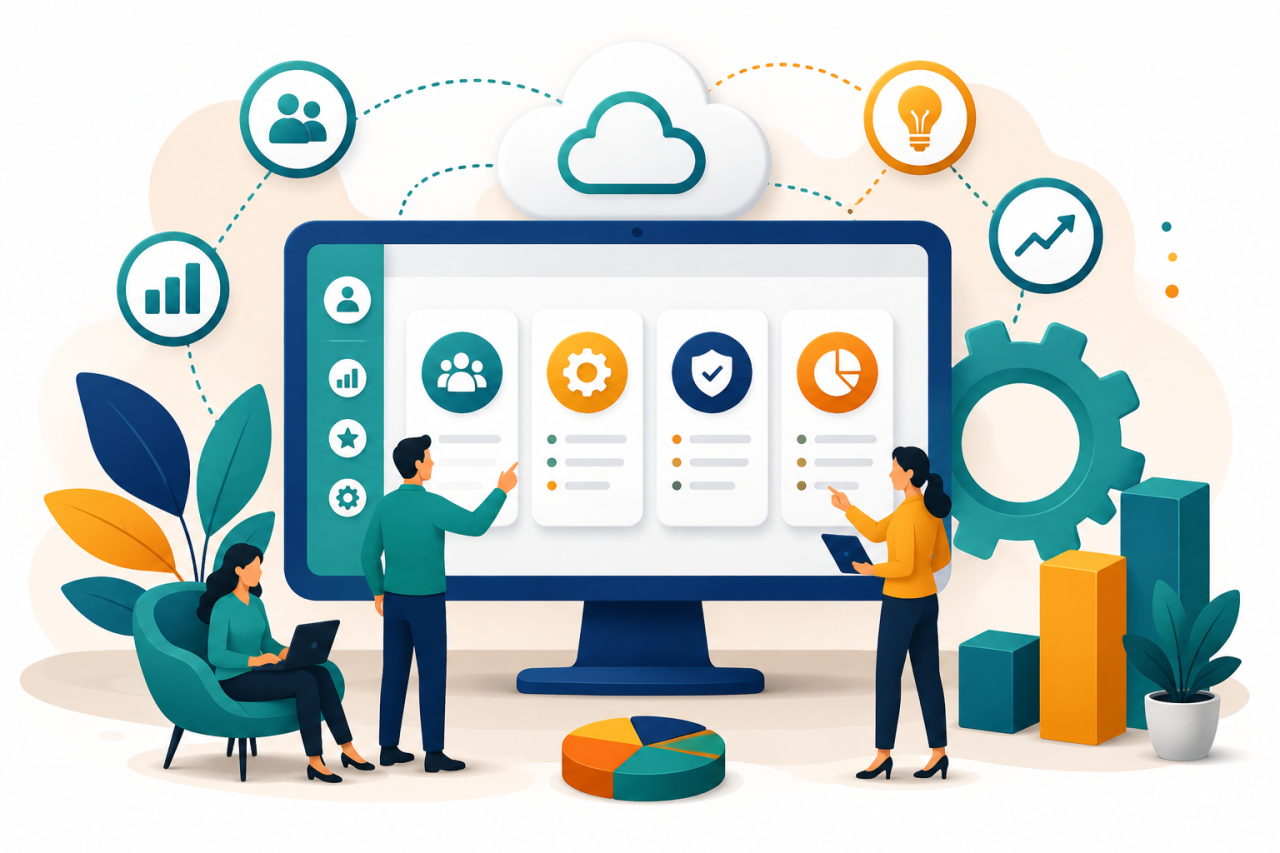
Several people ask, "What does Workday do?"
To simply explain the same, Workday, as a reputed ERP solutions provider globally, offers organizations a centralized platform to systematically manage their people, finances, as well as business operations.
Instead of the traditional way of maintaining separate software platforms for HR, recruitment, payroll, planning, finance, and analytics, Workday integrates all of these functions into one unified ecosystem.
For Human Resources teams, Workday efficiently manages all the employee records, recruitment, onboarding, compensation, benefits, performance reviews, succession planning, learning, & workforce analytics.
Finance teams use Workday for the purpose of budgeting, accounting, procurement of raw materials, expense management, audits, financial reporting, and compliance.
Executives benefit from its interactive dashboards and real-time analytics that provide the most optimal visibility into different aspects like workforce performance, financial health, operational efficiency, and potential business risks.
Because every single department works from the same source of data, the client organizations end up gaining a better level of collaboration, fewer manual processes, and also more informed decision-making.
This particular integrated approach is one of the primary reasons why Workday continues to replace the various other legacy enterprise systems across the world.
What is Workday Used For?
Business organizations use Workday to efficiently streamline various critical business processes while at the same time improving the overall operational efficiency and employee experience.
Some of the commonly used Workday solutions include the following:
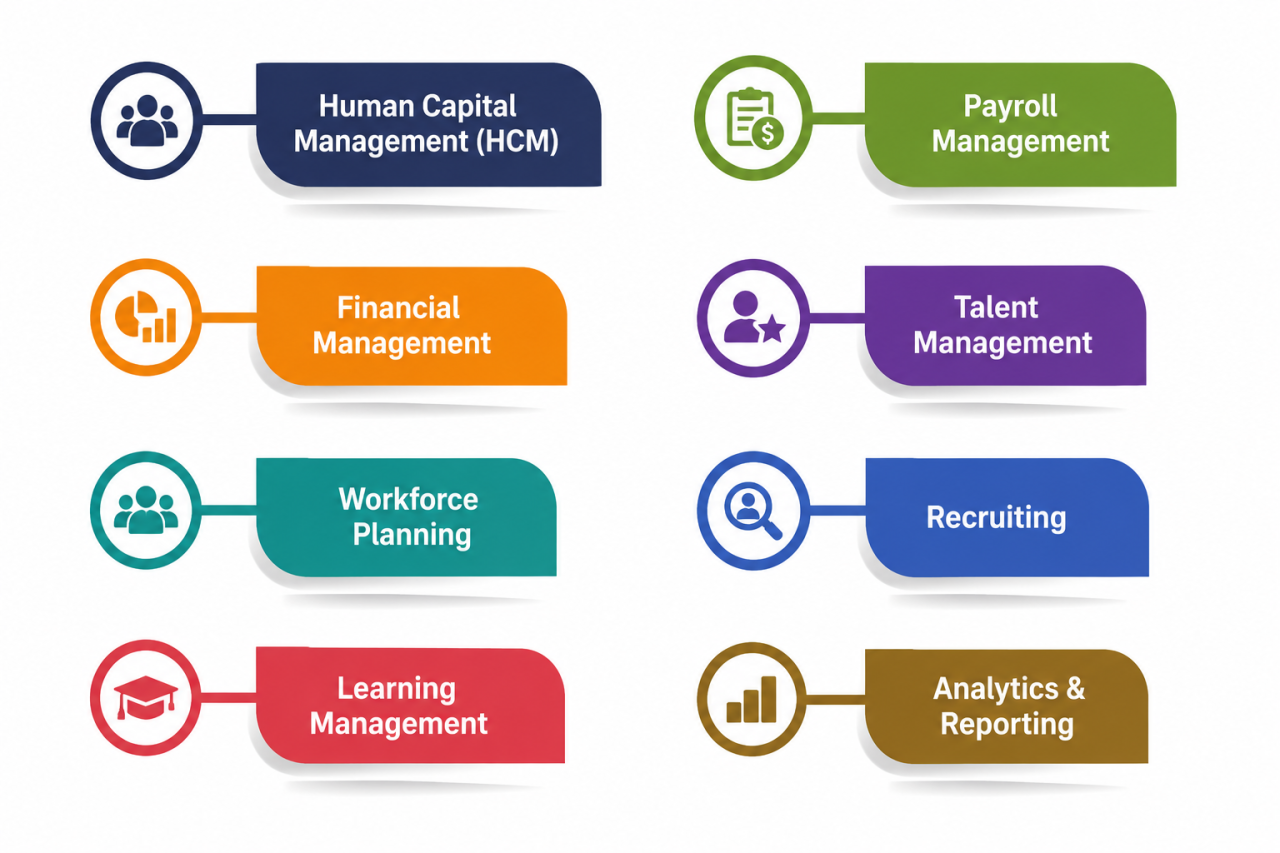
Human Capital Management (HCM)
Managing the employee lifecycle right from recruitment to retirement.
Payroll Management
Processing payroll accurately while at the same time ensuring tax and statutory compliance.
Financial Management
Managing all the accounting involved in a business, flawless budgeting, expense management, procurement, revenue, and financial reporting.
Talent Management
Supporting all performance reviews, steps for career development, succession planning, and also employee engagement.
Workforce Planning
Helping progressive business organizations to forecast workforce costs, hiring needs, and the requirements for organizational restructuring.
Recruiting
Managing all job postings, candidate applications, hiring workflows, interview scheduling, and onboarding.
Learning Management
Delivering all the desired employee training programs, certifications, compliance learning, and also professional development.
Analytics & Reporting
Providing all interactive dashboards and real-time business intelligence across HR and finance.
Since all of these capabilities operate on a unified data model, businesses eliminate duplicate data, reduce the tedious manual work, and gain the desired enterprise-wide visibility.
How Does Workday Work? (Workday System Architecture)
One of the major reasons behind the massive success of Workday is its modern cloud architecture.
Unlike various other traditional ERP software that are installed on company-owned servers, the Workday system efficiently operates as a Software-as-a-Service (SaaS) platform that is hosted in highly secure cloud data centres.
Users access the platform through a web browser or mobile application without the need for installing any software locally.
Every department - HR, Payroll, Finance, Planning, Procurement, and Analytics - works on a common data model. This specifically means that information that is being entered once becomes readily available across the organization in real time.
For instance, when HR hires a new employee, the information automatically becomes available to finance, payroll, learning, benefits administration, as well as reporting modules without requiring any duplicate data entry.
Similarly, salary adjustments automatically update workforce planning, budgeting, payroll calculations, and also compensation reports.
This unified architecture very significantly reduces the various data inconsistencies while at the same time enabling more and more executives to make the right decisions based on live information rather than mere outdated reports.
Workday also has the capability of integrating seamlessly with different external enterprise applications with the help of APIs and advanced integration technologies, allowing progressive businesses to connect ERP, identity management, CRM, banking, & third-party applications.
Its AI-powered automation considerably improves the overall level of productivity by reducing the frequency of repetitive tasks, recommending the desired actions, identifying any possible anomalies, and providing valuable intelligent insights.
The Cloud & Multi-Tenant Model
Unlike legacy enterprise software, Workday follows a multi-tenant cloud architecture. In this particular model, all customers share the same application codebase while at the same time maintaining complete isolation and the required security of their data.
This enables Workday to roll out new features, security enhancements, and performance improvements simultaneously to all customers without requiring individual upgrades.
Organizations therefore benefit from lower IT costs, higher availability, automatic maintenance, and also continuous innovation.
The cloud model also very efficiently enables the concerned employees using Workday to securely access Workday from their desktops, tablets, or smartphones, making the remote & hybrid work environments much easier to support in the long run.
Business Objects & the Workday Object Model
One of Workday's very distinguishing features is its object-oriented architecture. It organizes business data into the most reusable "business objects." A business object represents a real-world entity such as an employee, organization, supplier, position, customer, or cost centre. Instead of storing the information in isolated databases, Workday links all of these objects through predefined relationships. This ensures that data remains highly consistent throughout the platform.
For example, when an employee changes departments or receives a promotion within the same organization, the related business objects automatically update all the associated workflows, access the approvals, track the payroll, update the reporting structures, and also update security permissions. This interconnected model minimizes duplication of data, improves the overall reporting accuracy, and likely simplifies the automation process.
The object model also largely enables organizations to configure Workday without the need for any extensive coding, making it much easier to adapt to business processes as organizational needs continue to evolve.
Continuous Updates & Releases
Unlike the various other traditional ERP systems that require highly expensive upgrades every few years, Workday invariably follows a continuous innovation model for several years together.
Workday typically delivers two major feature releases annually, introducing several new and improved functionalities, regulatory updates, AI capabilities, performance enhancements, as well as security improvements. These particular updates are automatically deployed across several customer environments, ensuring that the organizations always operate on the latest version without any nature of downtime or complex migration projects.
This approach significantly reduces the high costs associated with IT maintenance while enabling more and more progressive businesses to adopt new innovations quickly. Customers also gain early access to various preview environments, allowing administrators to test the newly introduced features before production deployment.
The Workday Platform & Core Solutions
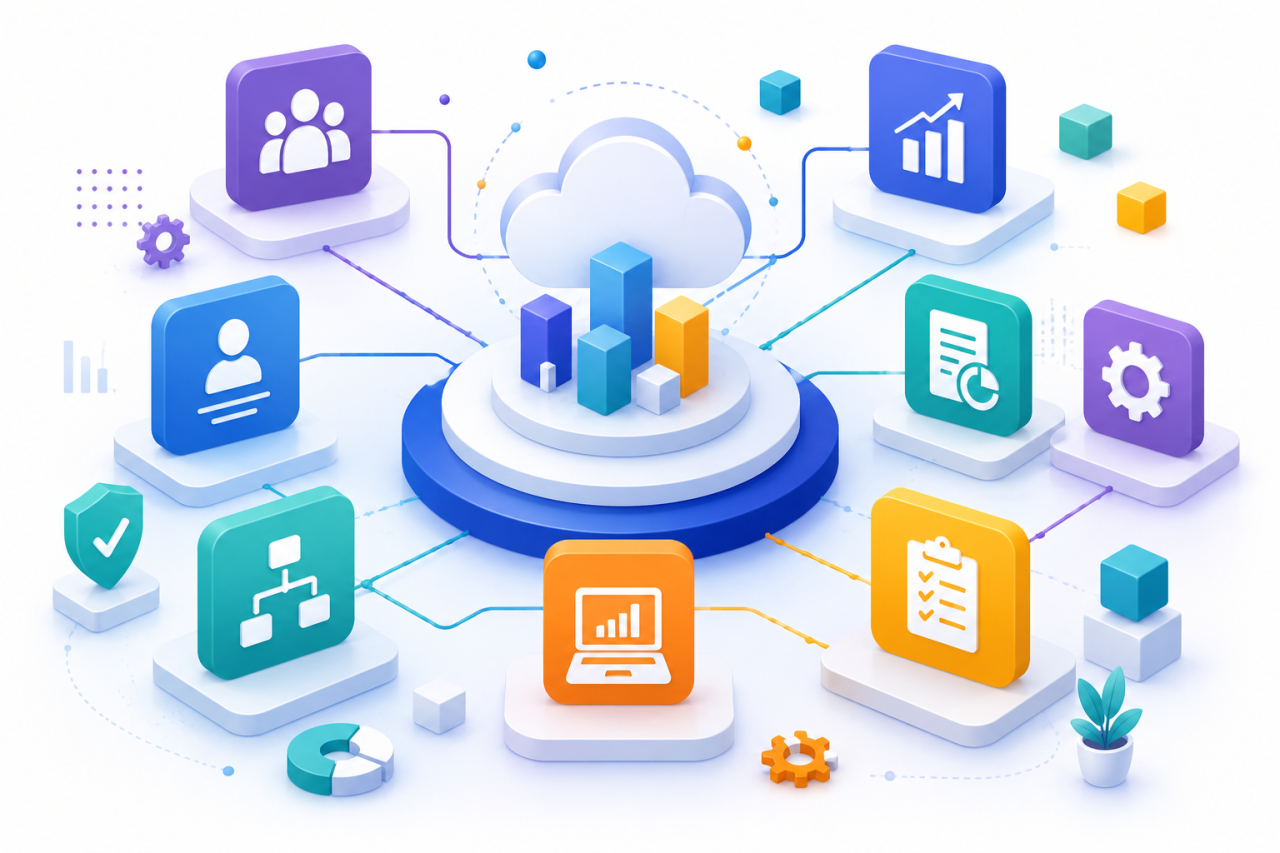
The Workday Platform serves as the foundation for all Workday applications, providing an altogether unified environment for managing enterprise data, integrations, workflows, reporting, analytics, and security.
Rather than functioning as separate software products, Workday solutions are very tightly integrated on a single cloud platform. This specifically allows HR, Payroll, Finance, Procurement, and Planning teams to collaborate using a common source of truth.
Core Workday solutions include:
Human Capital Management (HCM)
Financial Management
Adaptive Planning
Payroll
Recruiting
Talent Management
Time Tracking
Learning
Spend Management
Absence Management
Prism Analytics
Workday Extend
Because all the modules share the same data architecture, business organizations gain real-time visibility across various departments, leading to faster decisions and altogether improved operational efficiency.
Key Workday Modules & Solutions Explained
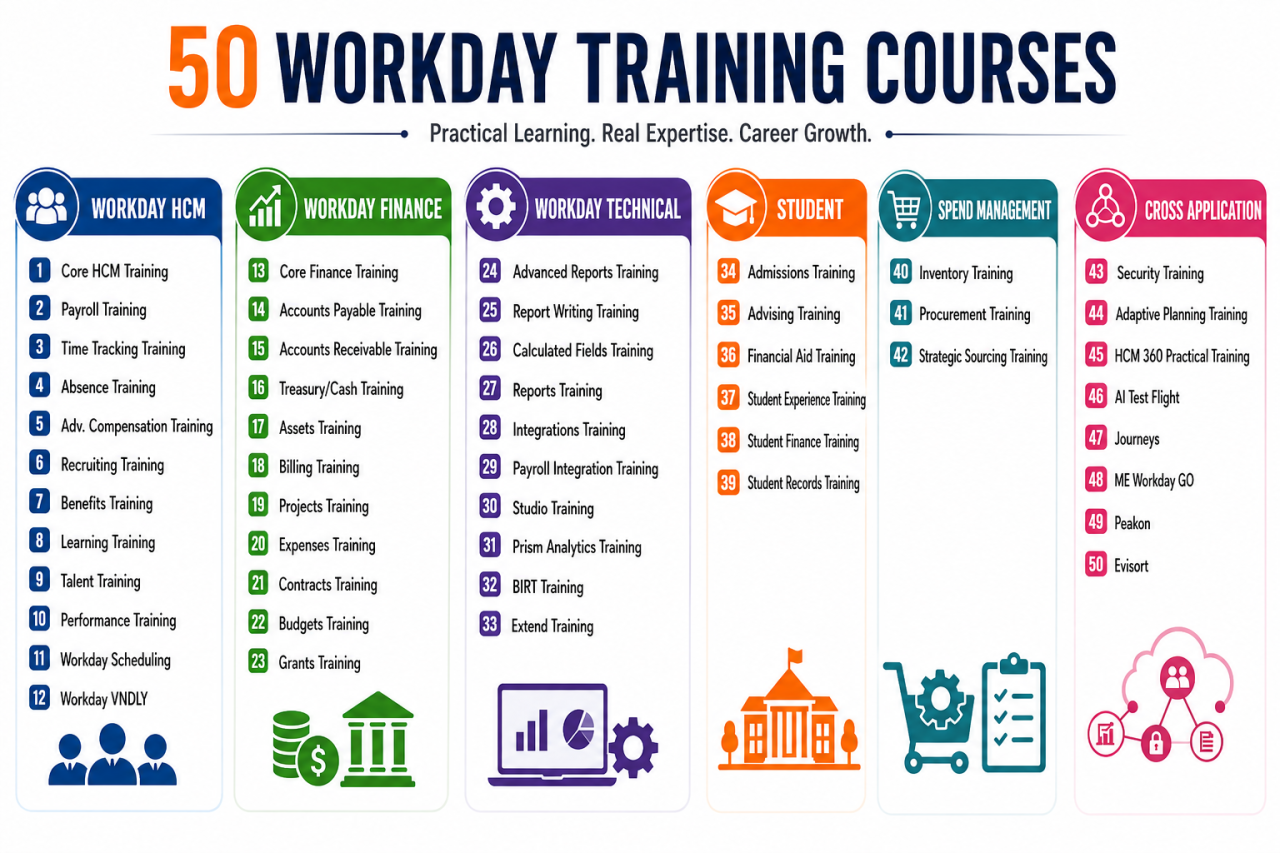
Workday solutions offer a highly comprehensive portfolio of various enterprise applications that are strategically designed to support every single stage of workforce and financial management. Instead of purchasing disconnected software, organizations at today’s time can deploy integrated modules which are well-tailored to their operational requirements.
Let us explore the most widely used Workday modules.
Workday HCM, Financial Management & Payroll
Workday Human Capital Management (HCM) is the flagship application of the platform. It manages the complete employee life cycle right from recruitment and onboarding to the various other aspects like performance management, compensation, succession planning, and retirement.
Workday Financial Management provides organizations with the most powerful tools for accounting, revenue management, budgeting, procurement, expense tracking, financial reporting, and compliance. Finance leaders gain real-time visibility into organizational performance through various interactive dashboards and analytics.
Workday Payroll automates the entire process of payroll processing while ensuring compliance with various statutory regulations, deductions, tax calculations, and employee compensation. Integrated payroll reduces the level of manual effort and considerably improves payroll accuracy across global workforces.
Together, these three modules form the major foundation of most Workday implementations. Since Human Capital Management is the platform's flagship application, a Workday HCM Course is often the preferred starting point for professionals entering the Workday ecosystem.
Adaptive Planning, Talent Management, Learning & Prism Analytics
Workday Adaptive Planning is a feature of the Workday program that enables progressive business organizations to forecast budgets, workforce requirements, financial performance, and various business scenarios with a high level of accuracy.
Talent Management helps business organizations and institutions to identify high-performing employees, conduct highly accurate performance reviews, define plans of career development, and also efficiently manage succession planning in various business sectors.
Workday Learning is a function offered by Workday that provides a highly centralized learning management system. This helps employees to easily access courses, certifications, compliance training, and also personalized development programs.
Workday Prism Analytics combines enterprise data from multiple sources into highly interactive dashboards and advanced reports. Decision-makers gain much deeper insights into the various workforce trends, operational performance, and various financial metrics, supporting much faster and more informed business decisions.
Recruiting, Time Tracking, Absence Management & Workday Extend
Workday Recruiting streamlines the process of hiring through various job requisitions, candidate management, scheduling of interviews, offer management, and onboarding workflows.
Time Tracking allows employees to record working hours while managers approve timesheets, overtime, and attendance through automated workflows.
Absence Management simplifies leave requests, accrual calculations, holiday planning, and policy administration while ensuring compliance with organizational leave policies.
Workday Extend enables progressive business organizations to build custom enterprise applications directly within the Workday ecosystem. Businesses can develop industry-specific solutions without the need to disrupt the core architecture of the platform, making Workday highly adaptable to various unique business requirements.
What is Workday Extend?
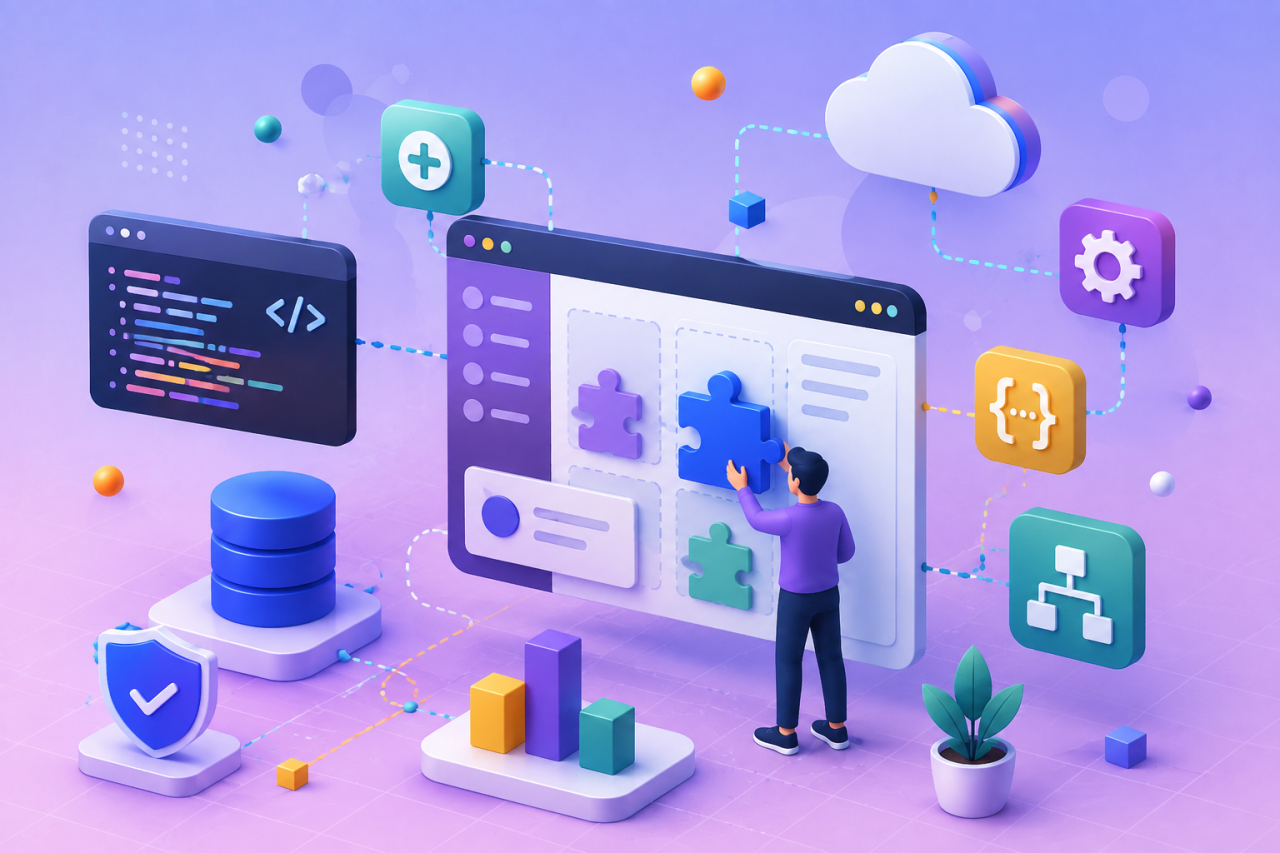
Workday Extend is a low-code/no-code platform for application development that allows progressive business organizations to build custom applications on top of the Workday Platform.
Instead of relying on various other external software for specialized business processes, business organizations can develop secure applications that seamlessly integrate with the already existing Workday data, workflows, reporting, and security.
Some of the instances include the following:
Employee wellness applications
Compliance tracking tools
Internal approval systems
Custom HR & finance solutions
Industry-specific workflows
Because all of these applications operate within the Workday environment, business organizations are able to maintain a highly consistent user experience while reducing the integration complexity and improving the overall governance.
Key Workday Terms You Should Know (Glossary)
Understanding Workday terminology makes the entire process of learning the platform thoroughly much easier.
Tenant: It is a dedicated Workday environment that is assigned to a business organization.
Business Object: This refers to a real-world entity such as an employee, position, supplier, or organization.
Business Process (BP): It is a configurable workflow that likely automates approvals and also the business transactions.
Worklet: This is nothing but small dashboard widgets that provide quick access to the frequently used tasks.
Calculated Field: It is a custom field that is derived from the existing data.
Domain Security: It is responsible for controlling user access to various specific business objects and functions within the Workday system.
Organization: It represents departments, companies, supervisory organizations, or cost centres.
Supervisory Organization: It is the primary management hierarchy that is being used within Workday HCM.
Integration: It refers to the arrangement of seamless data exchange between Workday and external enterprise systems.
Prism Analytics: This is an advanced analytics solution for the purpose of combining Workday and external business data.
Workday Extend: It is a strategically designed platform for building custom enterprise applications.
Adaptive Planning: It refers to Workday's planning and budgeting solution.
Report Writer: It is a competent tool that is being frequently used to create customized business reports.
EIB (Enterprise Interface Builder): It simplifies the processes of data import and export operations.
All of these concepts form the robust foundation for Workday implementation, administration, reporting, and consulting.
Top Benefits of Workday
Business organizations continue to adopt Workday because it very competently delivers the most measurable business value.
Some of its biggest advantages include the following:
It is a globally trusted unified Finance & HR platform.
Workday dependably offers the availability of real-time analytics & reporting.
This platform is undeniably modern and offers an intuitive user interface.
Its mobile-first accessibility is another great feature.
It offers a highly scalable cloud architecture
Its automatic software updates are highly useful.
The reduced infrastructure & maintenance costs are one of its greatest features.
Its strong security & compliance controls are highly commendable.
Workday offers configurable workflows without the need for any heavy customization.
It offers AI-powered automation & intelligent recommendations.
Workday offers faster decision-making through live dashboards.
It offers an improved employee experience.
This platform’s global payroll & workforce management capabilities are highly appreciated.
Its feature of seamless integration with the enterprise applications is highly commendable.
All of these benefits make Workday particularly attractive for a long list of progressive organizations that are seeking digital transformation while, at the same time, minimizing operational complexity.
Limitations & Challenges of Workday
Although Workday offers a host of advantages, organizations should also consider its challenges.
The implementation part can prove to be quite complex in Workday, and often it requires highly experienced consultants. Large enterprises may spend months together to configure the workflows, the reporting structure, security parameters, and also integrations.
Licensing costs can prove to be significant for smaller organizations, specifically when deploying multiple modules.
Because Workday emphasizes configuration rather than any kind of heavy customization, businesses that are already accustomed to extensively modifying legacy ERP systems may initially find its flexibility different and difficult to adapt.
Organizations also necessarily need structured change management programs in order to help employees adapt to the new workflows and also the different user interfaces.
Finally, while Workday supports a host of extensive integrations, connecting highly customized legacy systems may rationally require additional planning and also specialized technical expertise.
Despite all of these considerations, most of the business organizations adopting Workday view the long-term operational benefits as outweighing the substantial initial implementation effort.
Workday vs. SAP vs. Oracle & Other Alternatives
| Feature | Workday | SAP SuccessFactors | Oracle Fusion Cloud |
|---|---|---|---|
| Deployment | Cloud-native | Cloud | Cloud |
| HR Management | Excellent | Excellent | Excellent |
| Financial Management | Strong | Somewhat Limited | Strong |
| User Experience | Intuitive and Modern | Good | Good |
| Updates | Automatic | Scheduled | Scheduled |
| AI Capabilities | Highly Advanced | Advanced | Advanced |
| Custom Development | Workday Extend | SAP BTP | Oracle APEX |
| Most Suitable For | Unified cloud-based HR and Finance operations | Large enterprises with complex HR environments | End-to-end ERP and enterprise operations |
Workday undoubtedly stands out among other ERP systems for its highly unified architecture, greater level of user-friendliness, continuous innovation mode, and also integrated HR-finance ecosystem. SAP still remains very popular among those business organizations with highly extensive SAP investments, while Oracle offers a highly comprehensive ERP suite with, at the same time, very strong financial capabilities.
The best choice depends on the size of the organization, existing technology landscape, goals of implementation, & also long-term digital transformation strategy.
Who Uses Workday? (Companies & Industries)
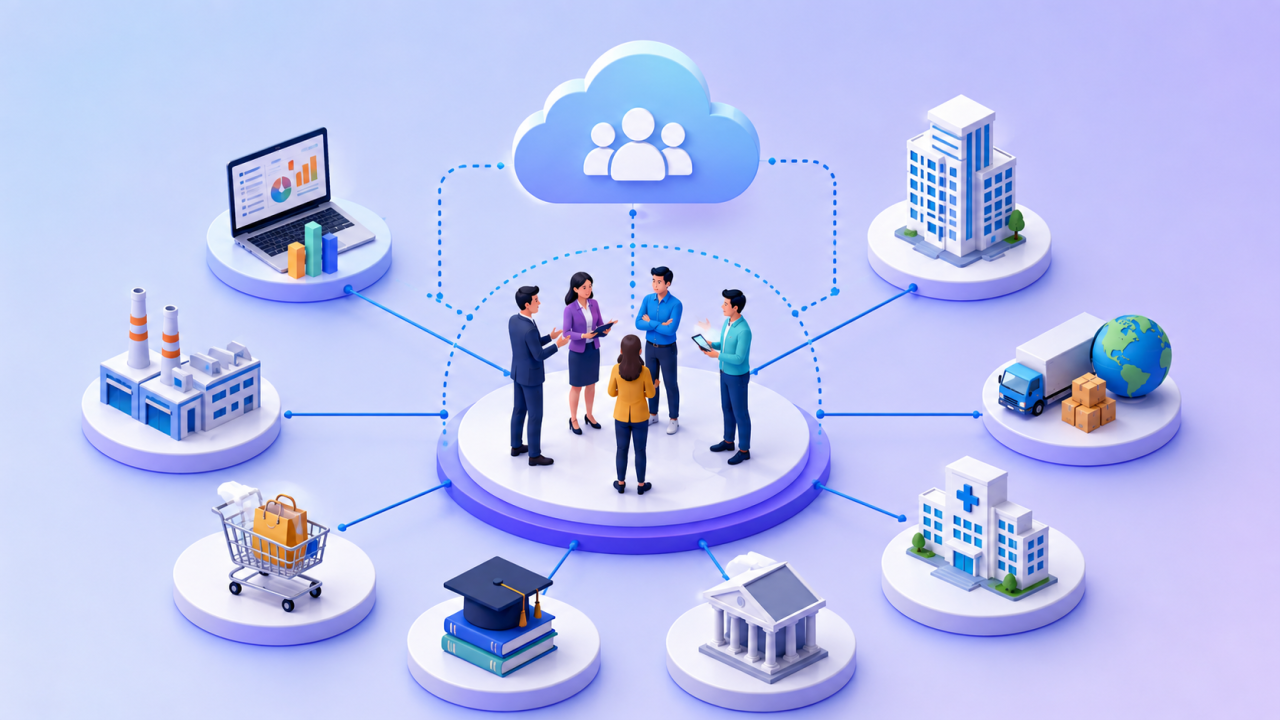
Workday is highly trusted by thousands of business organizations worldwide, including Fortune 500 companies, universities, government agencies, healthcare providers, financial institutions, manufacturers, technology firms, retailers, and professional services organizations.
Industries commonly using Workday mainly include the following:
Information Technology
Healthcare
Banking & Financial Services
Manufacturing
Education
Retail
Hospitality
Telecommunications
Government
Professional Services
Energy & Utilities
Pharmaceuticals
Its high level of flexibility enables business organizations of different sizes to competently manage workforce operations, planning, finance, & analytics on a single cloud platform.
The Future of Workday (AI & 2026 Updates)
Workday is transforming very rapidly, and in 2026 it has now become an AI-first enterprise platform. Various path-breaking recent innovations include Workday Illuminate, which embeds generative AI across HR & finance workflows to automate various repetitive tasks, provide different intelligent recommendations, and also improve the process of decision-making.
The company has also introduced the Agent System of Record, enabling business organizations to manage and govern AI agents alongside the human workforce.
Other major advancements include AI-assisted recruiting, predictive workforce planning, skills intelligence, automated financial anomaly detection, and conversational reporting. These particular capabilities help business organizations boost productivity while maintaining a strong level of governance & compliance.
As enterprises increasingly invest in the area of automation and intelligent decision-making, Workday's focus on responsible AI, unified enterprise data, and continuous innovation positions it as one of the leading cloud ERP platforms for the future.
Why Learn Workday? Career Scope, Roles & Salary
The growing adoption of Workday has created a very strong demand for skilled professionals throughout the world. The common career paths after learning Workday include the following:
Workday HCM Consultant
Workday Financials Consultant
Workday Technical Consultant
Workday Integration Consultant
Workday Payroll Consultant
Workday Security Consultant
Workday Administrator
Workday Business Analyst
Certified professionals often command highly competitive salaries because Workday expertise remains a highly specialized skill in the growing market of enterprise technology.
How to Learn Workday (Getting Started Path)?
If you are new to Workday, you should begin with a Workday Tutorial to understand enterprise HR and finance processes before finally exploring modules of Workday.
A recommended learning path essentially includes:
Learn all Workday fundamentals.
Thoroughly understand Human Capital Management.
Explore concepts of Financial Management.
Practice navigation in a Workday tenant.
Learn processes of business, reporting, & security.
Study integrations and Workday Extend.
Build the most valuable hands-on experience for the takers with the help of real-world projects.
Prepare for Workday certifications.
Instructor-led training with highly practical exercises significantly accelerates the entire learning process and also considerably improves your overall job readiness as compared to relying solely on documentation or watching videos.
Conclusion
Workday has fundamentally changed how business organizations manage people, finances, and business operations. Its cloud-native architecture, unified data model, AI-driven innovation, and continuously evolving platform make it one of the world's leading enterprise cloud solutions.
No matter if you are an IT leader evaluating an enterprise software, an HR professional exploring the most advanced digital transformation, or a technology enthusiast considering a new career path, thoroughly understanding Workday provides valuable insight into the future of enterprise applications.
Categories: : Workday Platform
Frequently Asked Questions
1. What type of software is Workday?
Workday is a globally recognized and highly popular cloud-based enterprise software platform that very competently combines Workday Human Capital Management (HCM), Planning, Financial Management, Payroll, Analytics, & also several other business applications.
2. Is Workday an ERP system?
Yes, Workday is a highly popular and modern cloud ERP platform. It very efficiently integrates HR, planning, finance, and analytics into a user-friendly unified system.
3. Is Workday an HR tool or more of a finance tool?
It seamlessly performs both HR and finance functions as it offers a unified platform. Workday largely supports comprehensive HR functions as well as financial management, making it a completely unified enterprise platform.
4. Is Workday actually a CRM?
No. Workday is not at all a Customer Relationship Management (CRM) system. It is an enterprise system that largely focuses on enterprise HR, payroll, finance, as well as planning.
5. How does Workday function?
Workday seamlessly operates as a cloud-based SaaS platform where all the business functions share a highly unified data model. It enables cloud-based real-time collaboration and reporting.
6. What is a Workday tenant?
A tenant is a highly dedicated Workday environment where a business organization's data, security settings, configurations, and business processes are safely stored.
7. Who owns or founded Workday?
Workday was founded by visionaries named Dave Duffield and Aneel Bhusri in the year 2005. It is now a publicly traded company listed on NASDAQ under the ticker symbol WDAY.
8. Is Workday better than SAP or Oracle?
The best platform depends on the business requirements. Workday is widely recognized for its user-friendly interface, unified architecture, and continuous cloud innovation.
9. Is Workday easy to learn?
Yes, Workday can be learnt easily. While enterprise concepts certainly require an immense level of practice, the highly intuitive interface of Workday and its well-structured learning resources make it one of the most accessible ERP systems to learn for beginners.
10. Is Workday a good career in 2026?
Yes, going for a Workday certification ensures a rewarding career in the year 2026. With the increasing global adoption and ongoing AI innovation, Workday professionals remain in high demand across different consulting firms and various enterprise organizations.
11. How long does it take to learn Workday?
Most of the learners can build a very solid foundation within just a passage of two to four months through well-structured training and hands-on practice. Advanced consulting skills typically require certain additional project experience, which is gathered over time.
12. Is Workday free to use or learn?
Workday itself is a commercial enterprise platform. However, many training providers offer introductory courses, live demos, and learning resources in order to help beginners get started.
Article written by
Mary is a globally recognized ERP and Workday expert, and the founder of ERP Cloud Training, with over 30 years of ERP implementation experience and 17+ years specializing in Workday. As a functional and technical subject matter expert, she was part of the original Workday design team and has led enterprise-wide deployments across 40+ modules, including HCM, Finance, Payroll, Recruiting, and Integrations, in collaboration with top-tier firms such as IBM, Accenture, PwC, KPMG, and Alight.
Mary is also a prolific Workday blog author, dedicated to sharing her decades of hands-on experience through insightful, real-world content. Her writing dives deep into critical and often-overlooked Workday topics—many of which have never been formally taught or published. By translating complex implementation lessons into practical blog content, she enables professionals and learners to gain industry-ready knowledge far beyond textbooks or theoretical guides.
Her passion for writing stems from a desire to pass on her 30+ years of wisdom to the next generation of Workday practitioners. Mary continually upskills herself with the latest Workday innovations and trends, ensuring her blogs reflect the most current, actionable insights in the field. As a featured speaker at Workday conferences, she shares implementation strategies, problem-solving techniques, and emerging best practices drawn directly from global project experience.
Through her blogs, Mary aims to empower professionals worldwide with the depth, clarity, and confidence they need to succeed in real-world Workday roles.